Archaic Fragments
The Reconstructed Languages of Kelly McKaig & Deborah Newmark
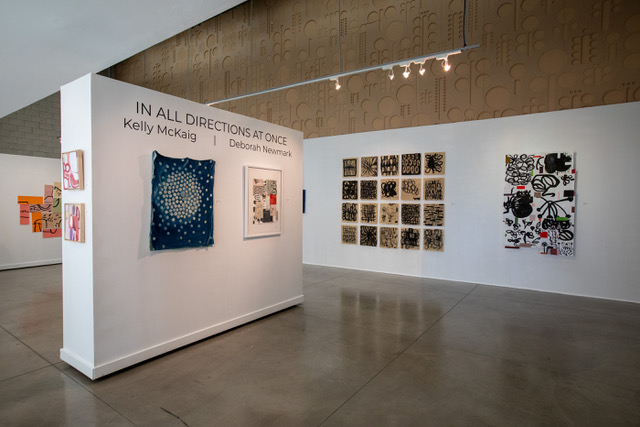
Seeing Deborah Newmark and Kelly McKaig in the exhibit In All Directions at Once is to encounter a visual language that is neither fully lost nor fully legible. Their marks and materials seem to belong to an older system of communication. This is where the exhibition gains its force. Newmark’s works compress and contain, while McKaig’s extends and releases. Across that tension, the viewer is asked not simply to look, but to assemble what remains.
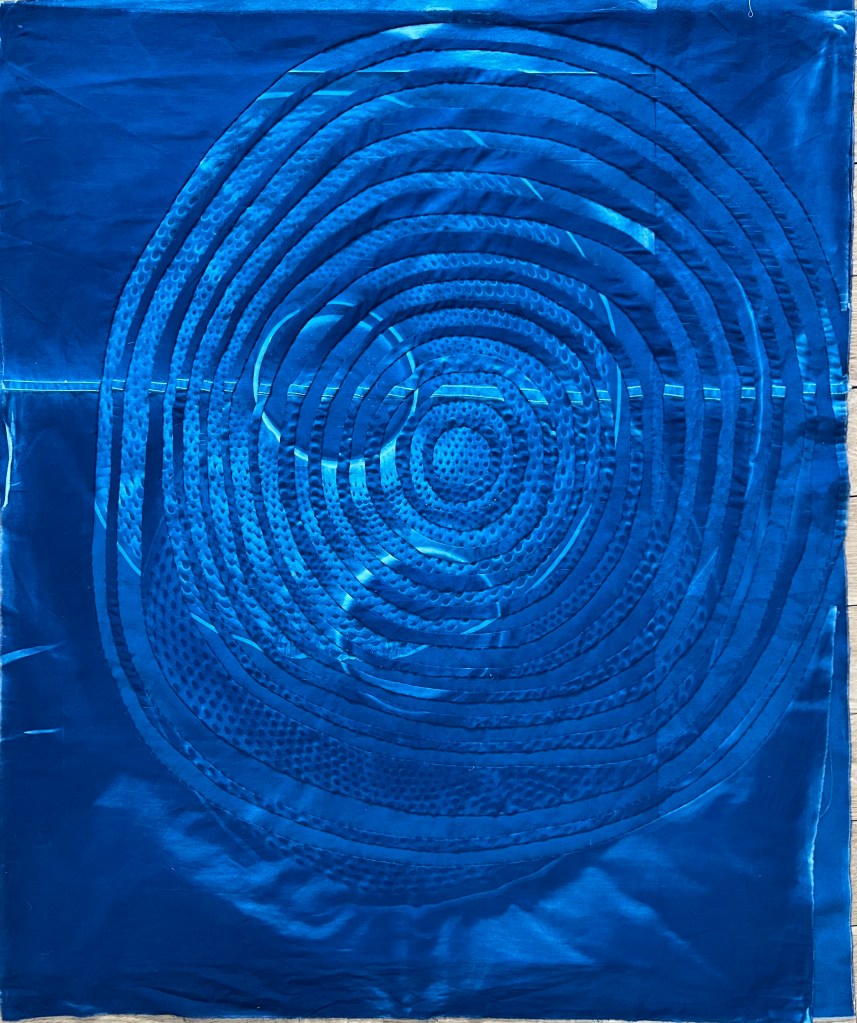
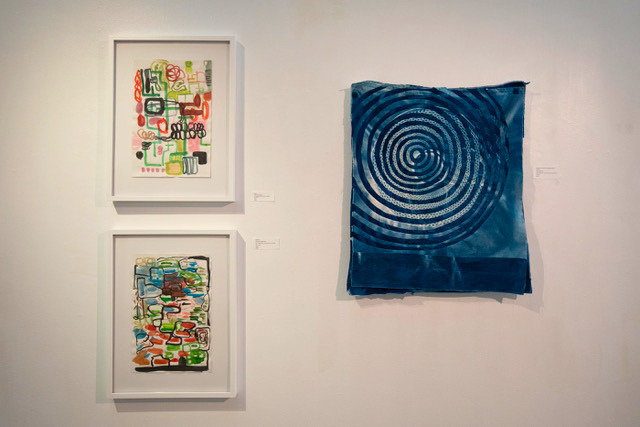
That dynamic emerges immediately in the pairing of one of McKaig’s soft blue textiles with one of Newmark’s framed collages. McKaig’s composition radiates without resistance, its circular pattern spreading across cloth as though it could continue beyond the edge if given more room.
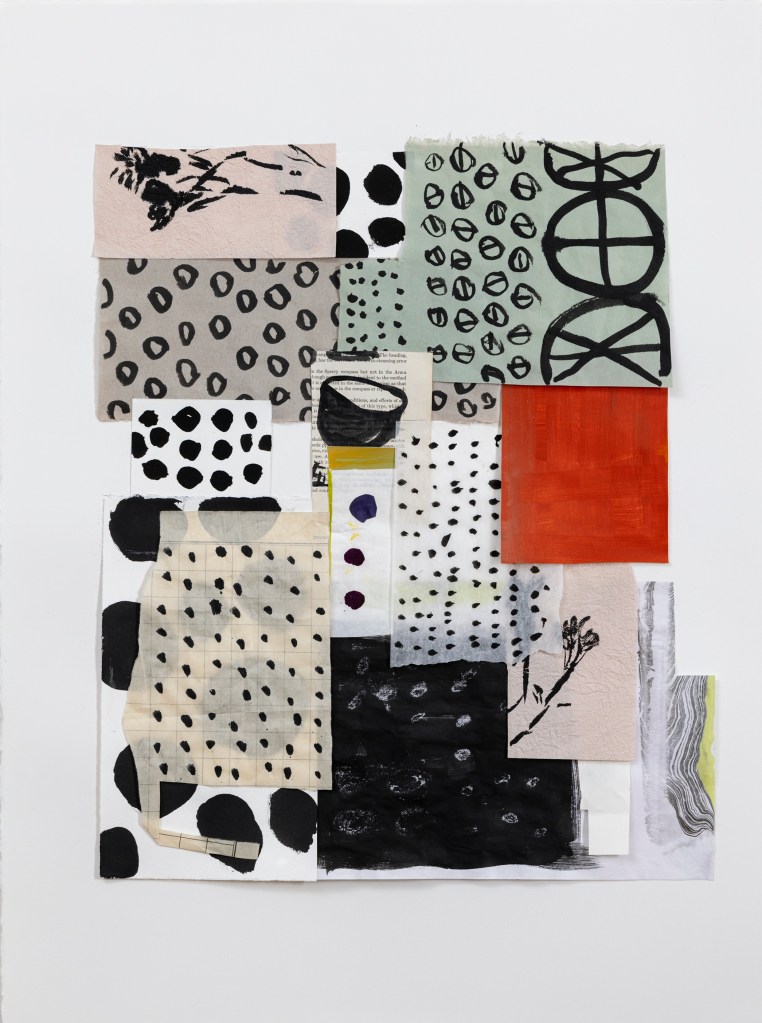
Newmark’s answers with a different pressure. Dots, fragments, and blocks gather inside a firm border that imposes a limit. The contrast sets the rhythm for the rest of the exhibition, establishing two distinct approaches to visual communication, one expansive, the other compressed.
McKaig’s sense of expansion continues in the book displayed with a pair of small white gloves resting on top. The gloves create uncertainty, leaving it unclear whether they invite touch or act to hold the page in place, as if insisting that your attention remain there.
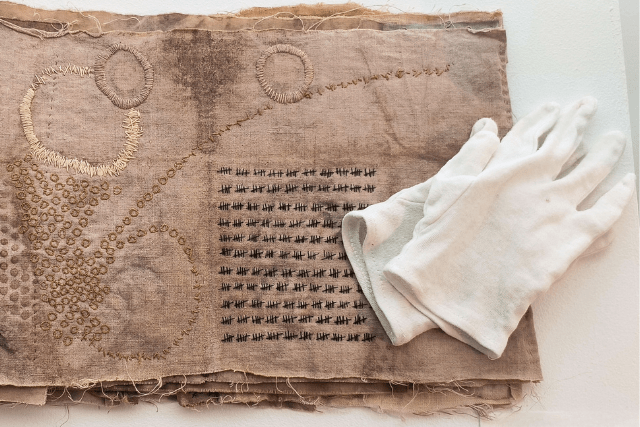
The repeated stitched marks across the pages suggest counting or record-keeping, recalling ways of tracking value and quantity through repeated signs rather than written text. They could refer to something ordinary, such as supplies or daily use, or to something more ominous, such as losses, warnings, or debts.
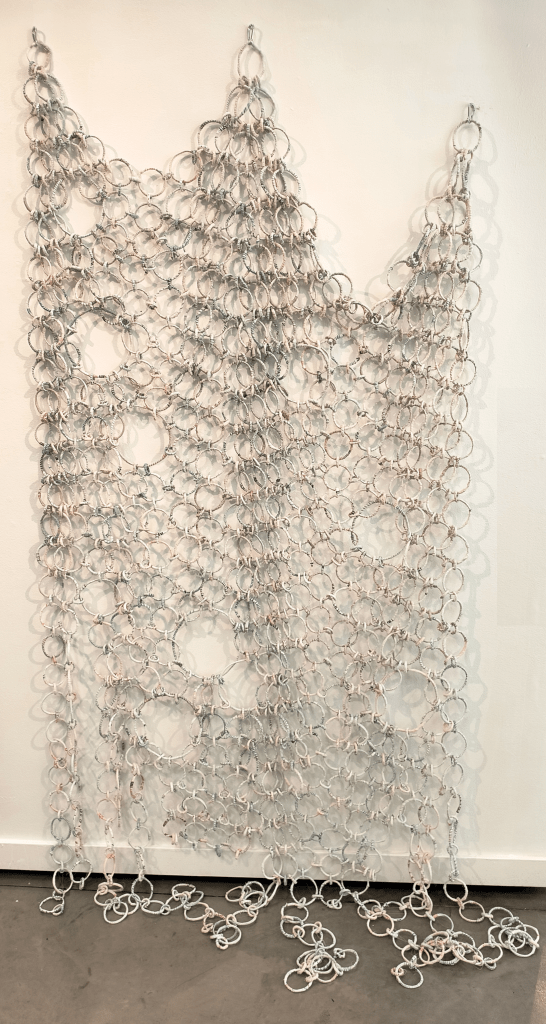
Elsewhere, McKaig introduces a different register through a hanging construction made of rings and thread. At first glance it recalls a net and therefore the idea of capture. Yet it resists full usefulness. Many of its openings are too wide, and it spills onto the floor with an exhausted grace that shifts it away from containment and toward release.
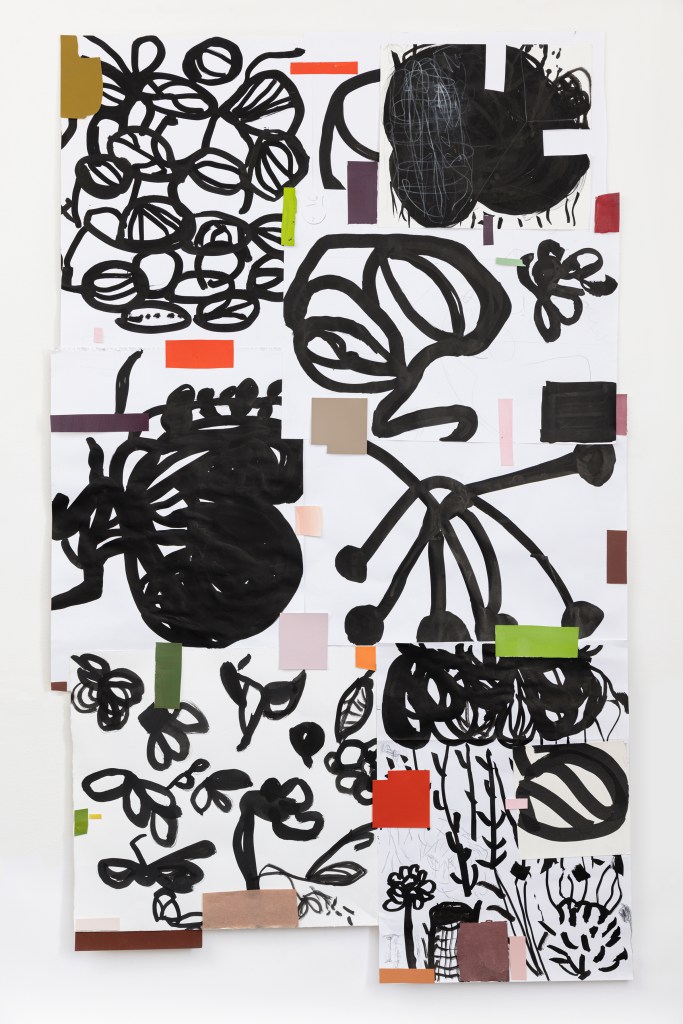
Newmark approaches the surface through density. In one large, seemingly paper-stitched composition, black moves across the field with authority. Color enters, though it never overtakes the dark marks. Those passages of black resist easy symbolic habits, especially the impulse to treat darkness as damage or threat. Here it becomes regenerative. Floral shapes rise through it. Gestural masses coil and gather.
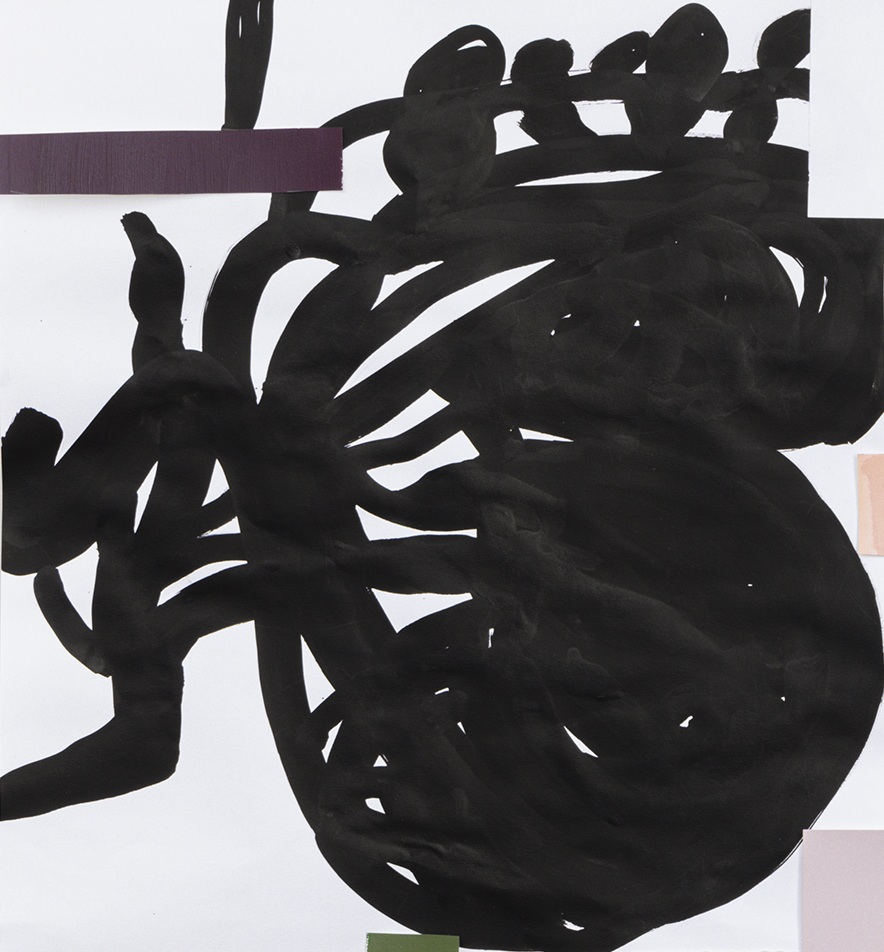
Near the center, a form assumes a fetal cast, folded inward in a way that suggests knees, torso, and enclosure. Its blend of botanical, embryonic, and abstract associations remains simultaneously in play, and that instability gives the work its charge.
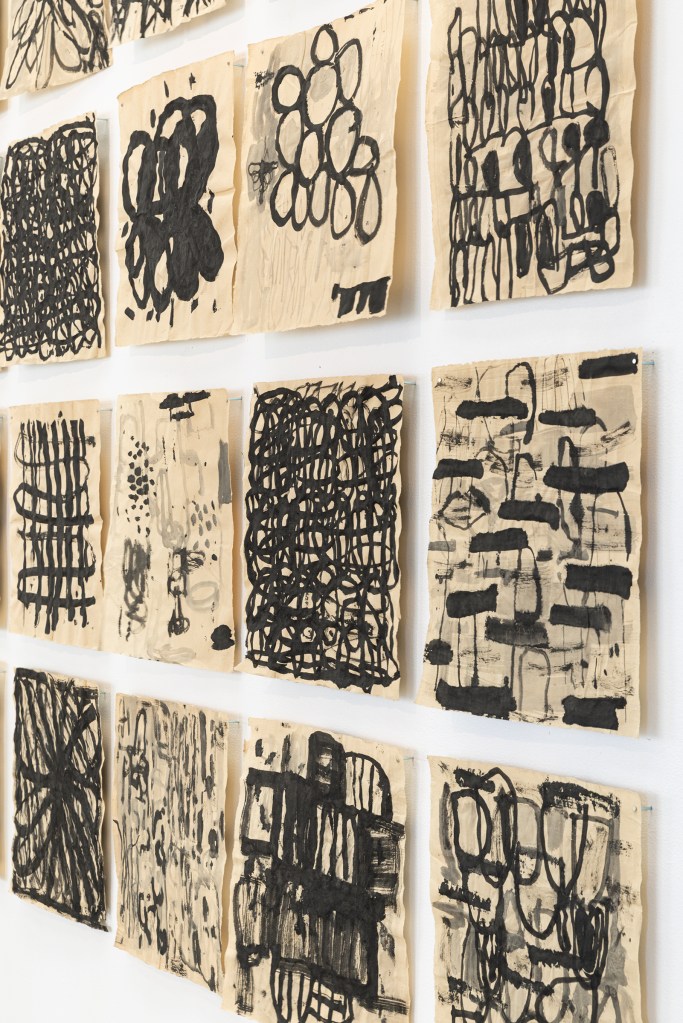
A nearby grid deepens this sense of coded transmission in Newmark’s practice. These works present themselves as remnants of an older order, carrying a message that has reached us only in partial form. Orbicular motifs, reticulated structures, aggregated marks, and stellate forms unfold across worn, chartaceous surfaces. The effect is pseudo-archaeological, offering not clarity so much as evidence, traces of a language that survives only in scraps.
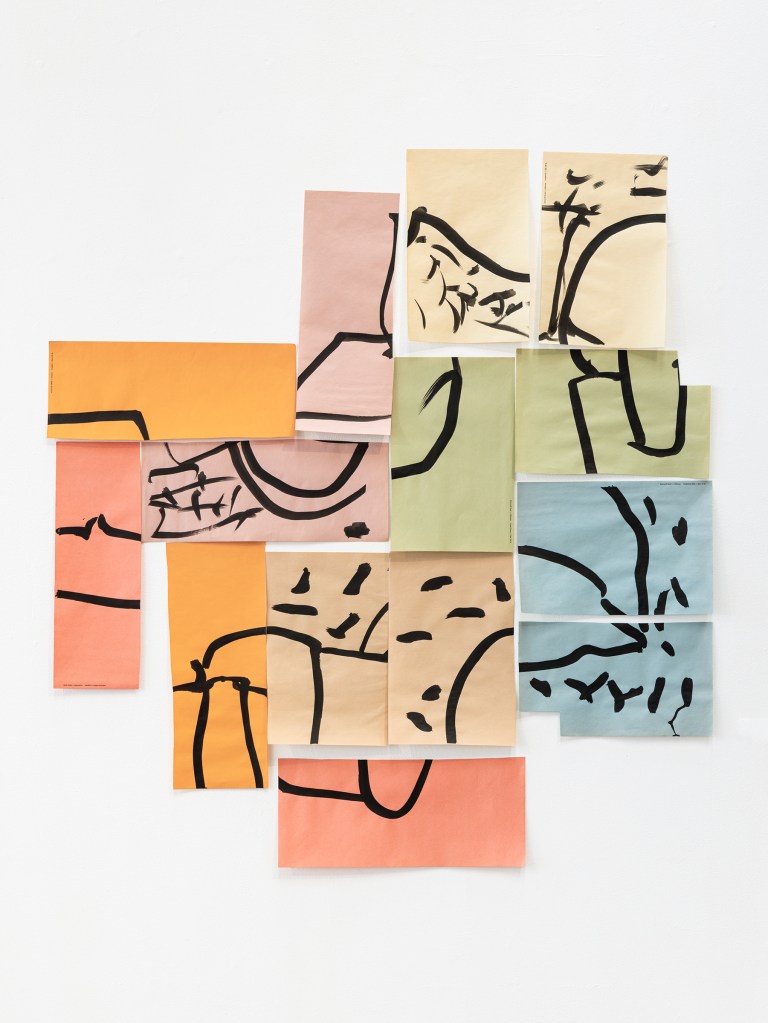
That same quality continues in another Newmark collage, where soft, dusty color and dark linear elements suggest the partial reconstruction of an artifact recovered in damaged condition. The composition holds the authority of something pieced back through intuition and guesswork, convincing yet slightly off. That wrongness is part of its power. Sun-worn, handled, and translated across time, it belongs to a world of sediment, weather, ruin, and endurance while still asking to be understood in the present.
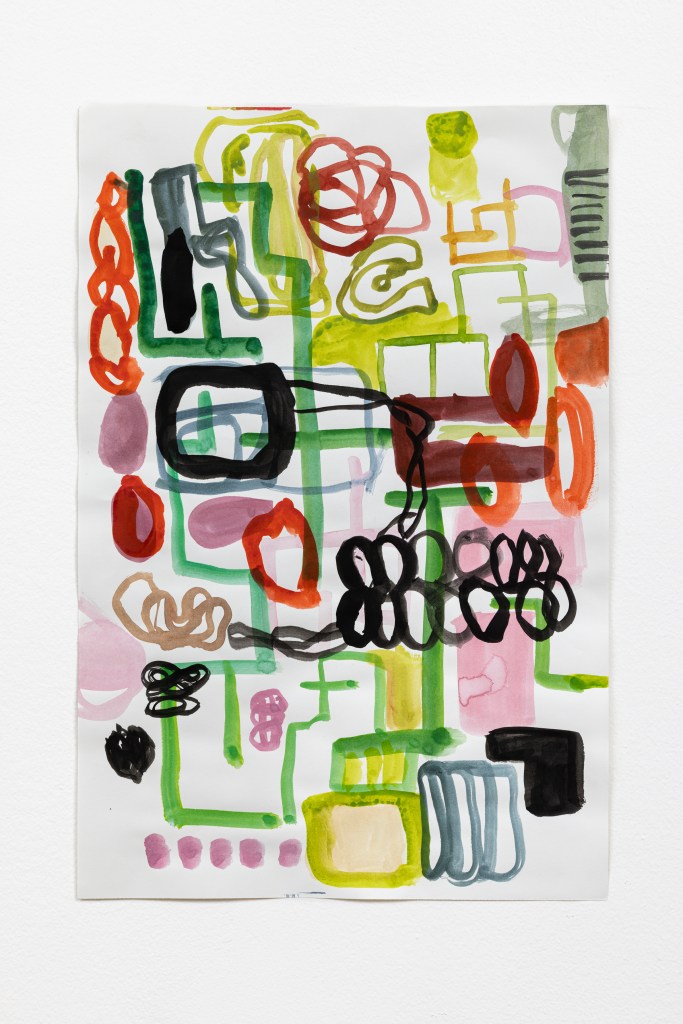
A subtler Newmark work near the close of the exhibition participates in that same tension. Pinks and greens introduce vitality, while heavier black passages press against the field with greater force. A clustered dark shape near the right side recalls teeth or cells. The composition resists settling into a single interpretation, hovering between bloom and threat and health and decay.
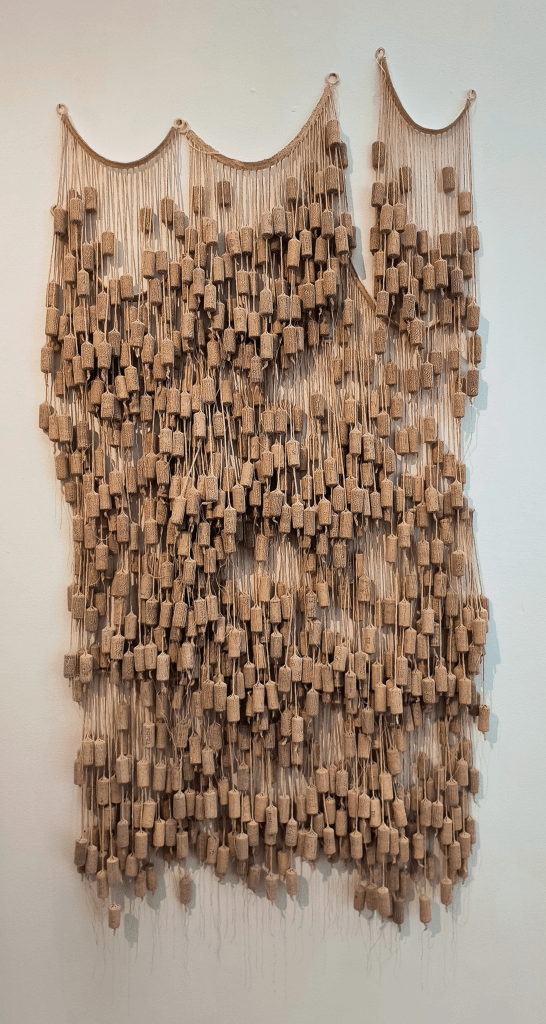
McKaig, by contrast, repeatedly moves toward a marine register. Silvery, saline residues and a faint sandy grit cling to the surfaces, reinforcing a sense of mineral saturation. Suspended threads, ringed elements, and open meshes suggest forms altered by submersion and pressure. The impression is less of construction than of recovery, as though these objects have been drawn up from a dark, sedimented below.
One hanging construction in particular, composed of thread, bars, cork, and plastic rings, suggests a device whose purpose has outlived explanation. It may once have served gathering, measuring, trapping, labor, navigation, or ritual. The object hangs as debris pulled from water and preserved after its original use was forgotten.
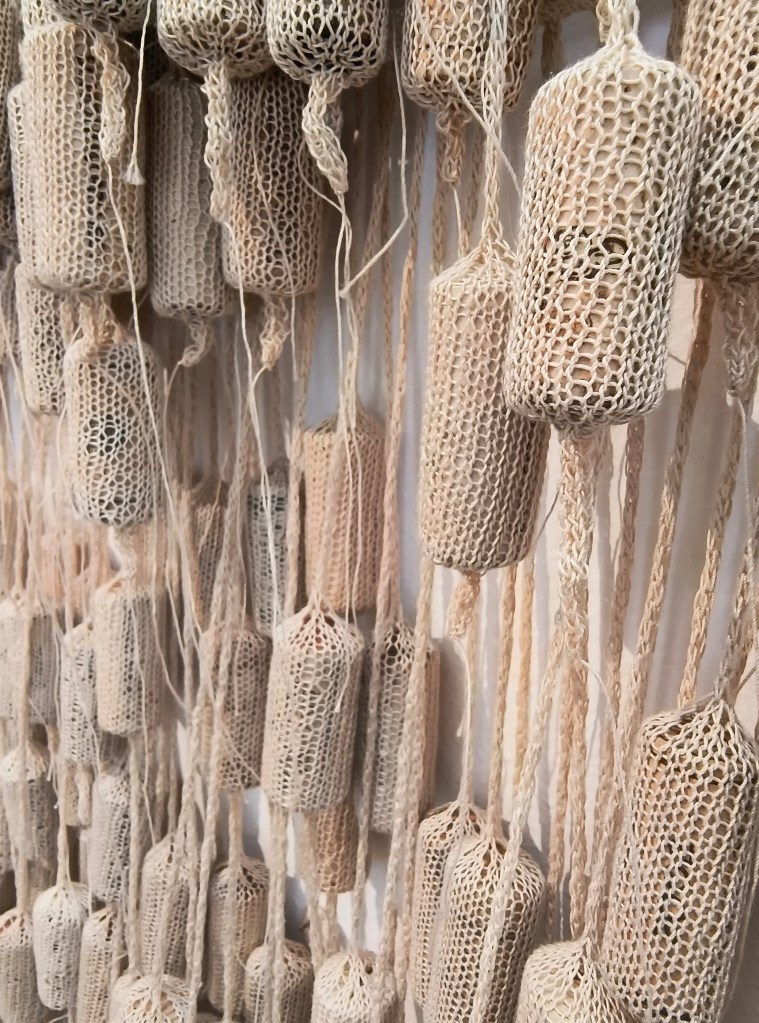
What gives the exhibition its strength is not simple contrast, but the way each artist clarifies the other. McKaig brings drift, openness, and motion. Newmark brings weight, compression, and the pressure of time. In relation, they make the central idea of the exhibition clearer, that both artists are building visual forms we can recognize as communicative without ever being allowed full access to what they say.
These are not mute remains. They are archaic fragments still trying to speak. McKaig and Newmark shape them differently, yet allow a shared language to surface slowly and never quite in full.
 Golden Arts Chicago